
Your Outfit Is Someone Else’s Exploitation
Who Paid for Your Look? (Hint: Not You)

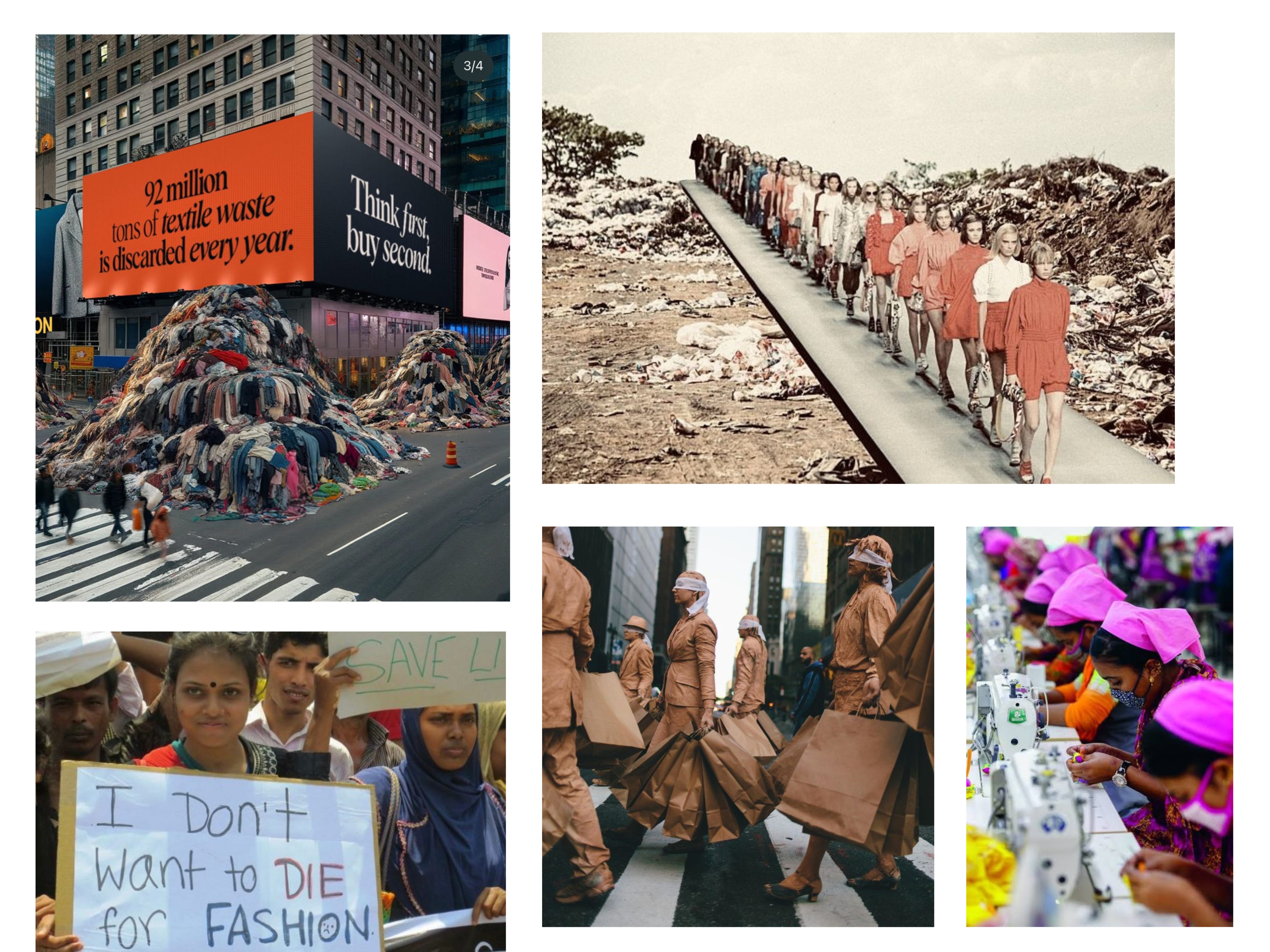
The fast fashion industry operates by rapidly designing, producing, and marketing inexpensive clothing, creating an illusion of accessibility for consumers.
This trend has gained momentum over the past few decades, as brands began releasing thousands of new styles each week. By quickly copying trending designs seen on social media and producing clothing at an astonishing rate, these companies sell apparel at much lower prices than before.
Unlike traditional fashion, which used to produce high-quality seasonal garments. Fast fashion is known to release hundreds, if not thousands, of items every week; often using synthetic fabrics such as polyester, nylon, acrylic, and rayon. While some may argue that these materials are durable, the underlying reality is that they are not durable and often take hundreds of years to decompose in landfills, while also releasing microplastics during wash cycles.
So why do consumers engage in such an unethical form of fashion? The issue stems from the price. For many people, seeing a price tag on a T-shirt from H&M and Zara retailing at $25 seems very doable, given that it is affordable, and won’t break the consumer’s bank account.
However, that is a very regressive mindset, as it continues to enable prominent fast-fashion brands such as Zara, H&M, Shein, ASOS, Cider, and more to overproduce, exploit labor across the global south, and harm the environment.
While a pair of jeans, a collection of blouses, or even a pair of expensive knock-off Loewe heels from Fashion Nova feeds a western buyer’s need for instant gratification, affordability, and staying on trend. The unfortunate reality is that this purchase also feeds into global inequality, labor exploitation, unsafe working conditions, and working overtime to meet each company’s quotas.
For example, a study by EarthDay.org in September 2025 found that “the industry employs approximately 60 million factory workers worldwide, yet less than 2% earn a living wage. Garment workers endure unsafe working conditions, wage theft, exhausting hours, minimal pay, and gender-based harassment.”
You would think that would be enough data for there to be serious calls to investigate fashion houses that engage in such unsafe working conditions, that put many marginalized communities within the global south in harm’s way, but unfortunately, it has become so normalized that some of the stories we hear about human rights violations don’t even shake us up anymore.
For instance, on April 24 2013, an eight-story commercial building located in the outskirts of Dhaka, Savar, Bangladesh, collapsed. The building housed several shops, banks, and various garment factories. The whole incident killed 1,134 garment workers , while leaving thousands injured. Despite the traumatic incident, many were required to return to work the following day per company guidelines.
In this case study, even 13 years later, the trauma remains fresh for many Bengali garment workers. As this tragic incident revealed not only heavily exploited garment workers, but also a complete disregard for major houses for unsafe working conditions.
An April 2023 report from The Daily Star found that, “the survey conducted by the Institute of Social Business on behalf of ActionAid Bangladesh said that 5.5 percent have been unemployed for the last three to four years.”
The example from the 2013 Rana Plaza is just one of many examples of labor exploitation. The issue here isn’t that it has happened. It has, and nothing can be done about that. The issue here is that it continues to happen, and corporations keep getting away with it without any repercussions.
The worst part? They know, and they simply could not care. Because in a world of capitalism and mass consumerism, why complain about it, especially when it is making you money?
In 2011, it was found that many Zara garment workers in South America were found to be working 16 to 19-hour days, with very little time off. To make matters worse, some of the workers were children. One being fourteen years old.
When contacted about this, an official from Inditex (the world’s largest fashion retailer and parent company of Zara) said in a statement that “it could not be held responsible for unauthorized sourcing,” but would compensate the workers because AHA had violated Inditex’s code of conduct.
The exploitation of individuals in garment factories throughout various countries in Asia, South America, and Sub-Saharan Africa just exploits the dystopian elements of society that we are continuing to see unfold right before our very eyes: algorithmic control, economic inequality, convenience trap, and information manipulation.
So the next time, you like the price of a dress, shirt, pants, jeans, or even shoes. You should ask yourself, is it worth it? Is this outfit worth someone else’s exploitation? Because in a world of constant information whiplash, it is important that consumers, especially in the global north, consume fashion that is not only sustainable. But also ethical.