
Who Profits From Your Outrage?
Activism but make it aesthetic

It quite literally feels like the world is burning before our very eyes. Between wars raging in multiple countries, political chaos destabilizing governments, climate disasters threatening entire populations, economic uncertainty affecting global markets and personal livelihoods, and the constant flood of information, it feels as though we are watching everything unravel in real time.
The hardest part isn’t just one singular crisis; it’s the overlap, the relentless cascade of emergencies that pile up faster than our minds can process. Social media intensifies this effect, making it feel like we are expected to follow, understand, and respond to every unfolding disaster simultaneously. Our brains simply aren’t built to handle the world at this scale, yet we scroll anyway, desperate to keep up.
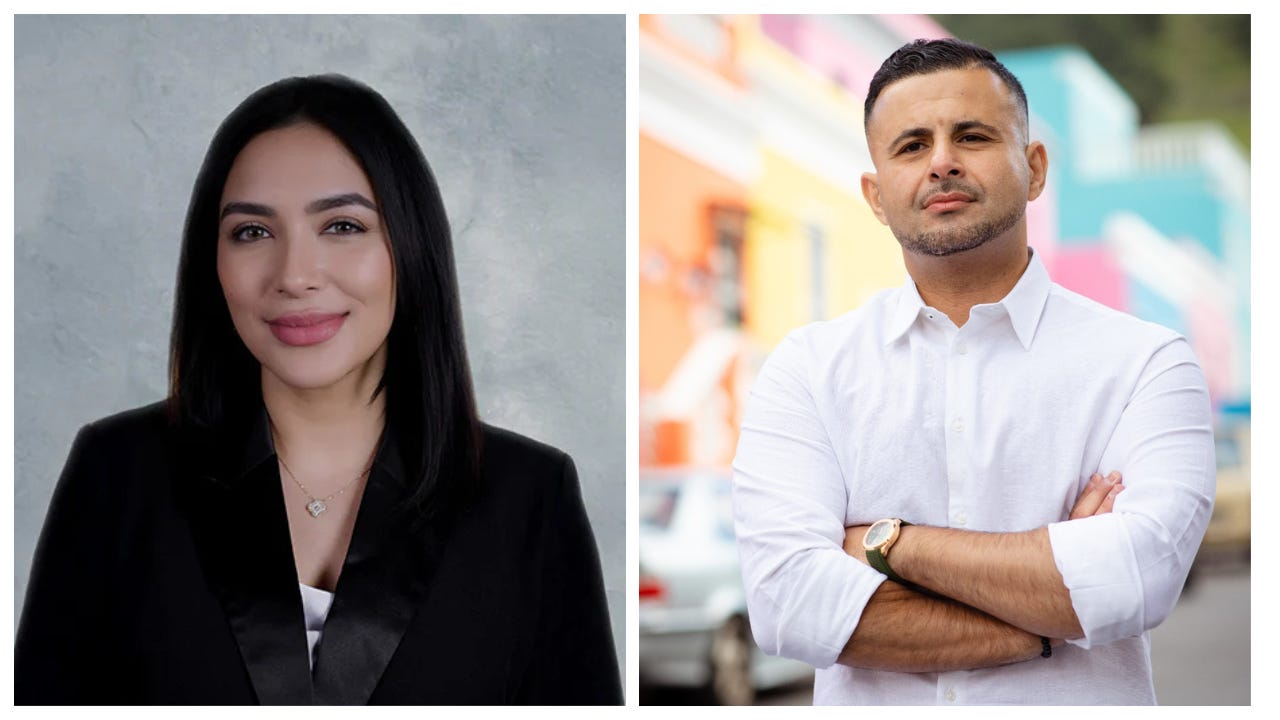
Recently, I came across a video circulating through prominent Muslim social media accounts accusing a handful of pro-Palestinian activists, Rosy Pirani and Khaled Beydoun, of essentially being frauds; profiting off outrage and suffering, and turning political crises into personal brands. It sparked a lot of discussion online, and it made me reflect: who are these so-called voices of Palestine? And are they genuinely representing the cause? Or just themselves?
Let’s start with Rosy Pirani. An American-Pakistani lawyer based in Houston, she has cultivated a social media presence blending commentary, advocacy, and personal branding. She has been vocal about the Gaza conflict since day one and has become one of the more visible voices in the diaspora community online.
Many people criticize her for perceived opportunism, claiming she grew her social media reach by posting about Gaza while launching her own brand. Others have questioned her transparency regarding donations and fundraising, leaving some to wonder about her intentions when discussing a deeply complex conflict.
The second figure is Khaled Beydoun, a law professor and commentator known for addressing civil rights, Islamophobia, and Middle Eastern issues. Social media users on platforms such as Instagram, X, and TikTok have accused him of lacking transparency in his fundraising campaigns.
Critics note that some donations were listed as payments to fundraising services, raising questions about how much money actually reached those in need versus how much was absorbed by administrative fees.
While both Beydoun, and Pirani have denied wrongdoing, the controversy illustrates how quickly public perception can conflate visibility with authority, particularly in times of crisis.
Am I surprised by these accusations? Not really. Since the armed conflict began on October 7, 2023, many influencers-turned-activists have amplified their voices around Gaza. This isn’t inherently bad. Raising awareness is important, but the system itself amplifies certain behaviors, often rewarding visibility and performance over nuance, depth, and accuracy.
These influencers don’t just talk about politics; they are politics, at least online. Their feeds are a constant stream of commentary, reactions, explanations, and curated resources. They make global crises digestible, shareable, and, most importantly, emotionally compelling. They become part educator, part commentator, part brand.
Yet these individuals aren’t necessarily the most qualified or informed; they are consistent, confident, and skilled at presenting a clear narrative, establishing moral authority, and reassuring audiences that they are on the “right” side of history.
The danger isn’t that influencers perform in politics. It’s that social media rewards performance over truth. When complex realities are reduced to clean, shareable narratives prioritizing audience engagement over accuracy and speed over reflection, the consequences can be harmful.
Politics is rarely simple, yet we consume it as if it were a digestible story. Influencer-driven activism, in many ways, resembles subtle propaganda: the loudest voices dominate, often silencing those with a deeper understanding, while moral outrage and certainty are amplified over nuance and careful reasoning.
In this environment, caring becomes performative, attention becomes authority, and truth is often replaced by what is most visible. We follow voices that resonate with our preexisting beliefs, share posts that reinforce our worldview, and reward clarity over complexity, confidence over uncertainty.
We don’t just consume content; we shape it. And the feedback loop of likes, shares, and comments incentivizes both influencers and audiences to favor spectacle over substance.
We must be critical of the content we consume. Visibility is not credibility; virality is not truth. Navigating responsibly means actively seeking diverse perspectives, listening to those directly affected, and questioning prevailing narratives.
Awareness filtered through one lens is insufficient. Real understanding requires digging deeper, holding contradictions, and making space for voices that may not be the most visible but are often the most essential.
Influencer activism has the power to inform, inspire, and mobilize, but it also carries the risk of distorting reality, flattening nuance, and promoting a curated version of truth optimized for attention.
In an age of constant, overlapping global crises, the stakes of this distortion are high. The next time you scroll through your feed and see a familiar activist voice, ask not just ‘Do I agree?’ but also ‘Why am I seeing this, and who benefits from me consuming it this way?’ Because in a world that feels like it is burning, thoughtful engagement and critical consumption are not optional; they are necessary.