
Luxury’s Dirty Secret: The Hidden Labor Behind Haute Couture
The Politics of Invisible Labor.

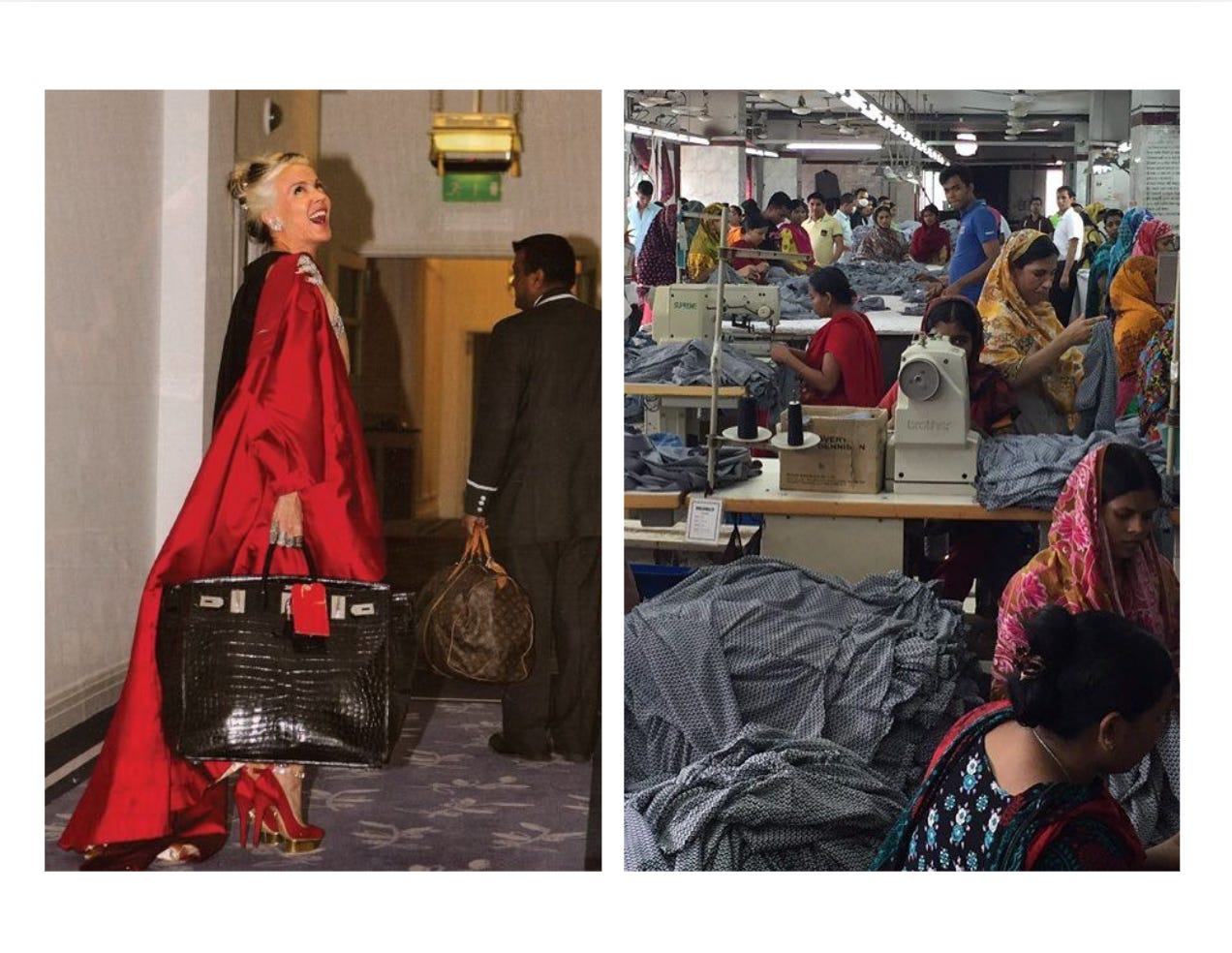
Every year, the most precious and valuable fashion houses in the world, led by Chanel, Louis Vuitton, and Hermes, position themselves as exclusive symbols of heritage and craftsmanship in high fashion. Yet behind the grandeur lies another reality: lack of fundamental freedoms.
Many of these robust fashion houses enable multiple forms of human rights abuses. This can be seen through severe labor exploitation, forced labor, and unsafe working conditions that have left many marginalized and economically vulnerable workers unsafe.
A report published by the Business and Human Rights Centre in December 2024 found “28 cases of alleged human rights abuses linked to ruthless brand purchasing practices from March to September 2024. These cases impacted thousands of workers across the world, including in Indonesia, Portugal, the Philippines, eSwatini, Argentina, China, Estonia, Kenya, Bangladesh and Romania.”
This raises a troubling pattern in the realm of luxury fashion. It makes you wonder about the reality of the unhidden. Can an exclusive $12,000 handbag still involve underpaid workers in the Global South? Does “Made in Italy” obscure migrant labor exploitation? And are luxury brands really that different from fast fashion, or is that a hoax?
For decades, luxury brands have successfully marketed themselves as untouchable. The appeal has attracted millions of buyers and fashion consumers from around the world. As these brands continuously center themselves as the epitome of sustainability, feminism, artisanal heritage, and timelessness, who has paid the cost?
It isn’t the large luxury conglomerates like LVMH or Kering. It isn’t company shareholders, executives, or even consumers. Then who is it?
It is garment workers in China, Bangladesh, India, and Vietnam. It is the migrant laborers in Italian subcontracting workshops. It is the tannery workers who are being exposed to toxic chemicals like chromium and formaldehyde on the job. It is the everyday communities throughout the Global South who are trying to meet their basic needs, while the West continues to exploit their countries’ resources. Most importantly, it is exploited children.
In 2024, a BBC investigation found that “last summer’s perfume supply chains found jasmine used by Lancome and Aerien Beauty’s suppliers were picked by minors.”
This should raise eyebrows and prompt concern. From one angle, luxury brands portray themselves as champions for supply chain transparency and resistance against child abuse and systemic racism.
In a 2019 Human Rights Policy Impact report, Prada Group, a leader of luxury, stated, “The Group strictly prohibits forced labor, including but not limited to modern slavery and human trafficking under any circumstances.”
Despite these progressive claims, the brand has been on almost every front page with supply-chain labor abuse, safety violations, and racist imagery and retaliation.
They don’t practice what they preach.
This is an example of beauty built on invisible labor. This forces conglomerates to those within the Global South and beyond.
In 2020, a human rights coalition revealed that nearly the entire fashion industry in Uyghur forced labor from the Xinjiang region in China: “Global fashion brands source so extensively from Xinjiang that the coalition estimates that it is ‘virtually certain’ that as many as one in five cotton products sold across the world are tainted with forced labour and human rights violations occurring there.”
Despite so much awareness, especially in recent years, why are these abuses still happening? Why haven’t fashion brands done anything to put an end to it?
According to earthday.org, “It’s evident that neither the governments nor the companies are taking adequate action, as they continue to prioritize profits over the safety and fair compensation of workers. There is hope, however.”
There are ways we can force corporations to stop unjust practices. This can be seen through practicing conscious consumption, advocating for stronger mandatory human rights due diligence laws, and transparency laws. Most importantly, it can be done through elevating the voices of the weak, amplifying them through worker unions, labor rights NGOs, and investigative journalism focused on supply chains.
Cultural industries shift when public discourse shifts. That is why we must keep talking about the persistent inequality within the fashion industry. While the industry has built a name for itself on glitz and glamor, it is important that we mitigate the harm it continues to cause to vulnerable workers within the Global South.
Collectively, we need to do better for the sake of the next generation, environment, and industry. It is time that we wake up and learn to take a stand.