
For My Nano: A Love Letter During PSP Awareness Month
She Was Never Just Her Diagnosis

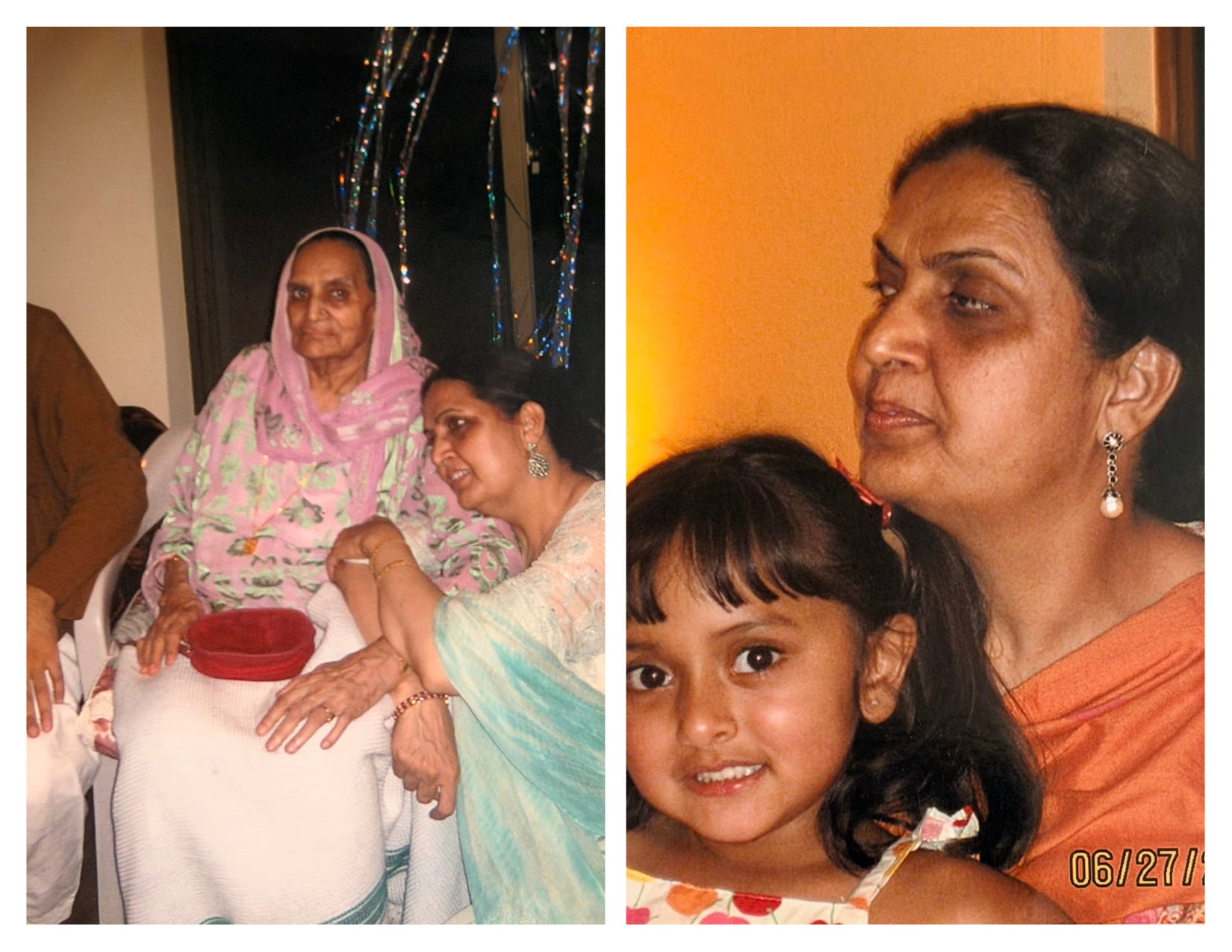
My Nano was the backbone of our family. She was the person who held everything together in ways that went unnoticed at the time. The keeper of routines, the one who remembered every birthday, every story, every detail that somehow only she could remember. Families have people who become their center of gravity, and for ours, it was my maternal grandmother. My Nano. My Ami.
There are some people whose presence becomes so woven into the rhythm of your life that you can’t imagine existing without them. You don’t notice how much they carry because they do it so effortlessly. Then one day, when they are gone, you learn that the traditions, the warmth, the feeling of home itself had a person behind it.
I will be honest here, up until a few years ago, I really never knew what grief felt like until I lost my Nano.
Here is what no one tells you about grief. It’s a weird feeling. People will often tell you that grief is sadness, but no one tells you about the strange parts. They don’t tell you how grief can appear in ordinary moments. How can it hide in a recipe, a smell, a holiday, a home, or in a random thought on a Tuesday afternoon? How can someone be gone but still exist everywhere?
Diseases have a distinct way of entering a family quietly. At first, PSP was just a name. Then it slowly became part of our vocabulary, part of our routine, part of conversations we never expected to have.
For those who are not familiar with the disease, PSP, also known as Progressive Supranuclear Palsy, is a rare neurological condition that gradually affects areas of the brain involved in movement, balance, eye movements, speech, and thinking. It continues to be one of the most uncommon diseases of our lifetime, affecting 6-10 individuals per 100,000, with about 30,000 cases in the United States.
It’s so strange how something so statistically rare can become so deeply personal. How one medical diagnosis can suddenly become part of your family’s story.
Looking back, I was old enough to remember my Nano before everything changed. But at the same time I was young enough to not fully understand what was happening (the constant appointments, diagnosis, and whispered conversations amongst adults).
I remember being quite spiteful to my mother during those turbulent years. Looking back, I wish I hadn’t. But at the same time, I couldn’t help myself. I was a teenager, in high school, trying my best to navigate my life and hormones. When I reflect on that period, I feel bad about my attitude, but I did the best I could for a fifteen- or sixteen-year-old.
I remember that while my mother was at work, I would wake my Nano up from her nap. I would get her ready for evening prayer, help with her wudu, fix her hair, and dress her. I would warm her turmeric-honey milk, and turn on a Pakistani drama while I massaged her feet for comfort. Initially, it was hard learning how to care for a sick grandparent at such a young age. However, even then, I knew someone whom I loved deeply needed my support.
During this time, while caring for my Nano, I grew so much as a person: forming deep empathy and compassion, learning to manage stress, and developing disciplined time management. It gave me perspective on life’s fragility and how much I value the joys, experiences, and pride that come with family.
But it also did another thing: her diagnosis and my time taking care of her taught me to be reflective. Writing about her has followed me through different chapters of my life.
I have written about my Nano’s story during my college applications, my transfer applications, and most recently, my business school applications. Looking back, I realize I keep returning to her story because it never really felt like hers; in many ways, it shaped part of mine as well.
At first, I thought I was writing about resilience, family, or the way difficult experiences shape us. But now that I think of it, I was writing about grief.
Maybe because losing someone doesn’t happen at once. People talk about loss as though it were one moment. One day. One phone call. One goodbye. But grief keeps reintroducing itself. It appears when you reach milestones. It appears when your life changes. It appears when you wish someone were here to see the person you are becoming.
I quickly realized that grief was less about forgetting someone and more about carrying them forward. Because even two years later, there I was writing essays about my future and somehow finding pieces of her in them. Maybe that’s because some people never really leave your story. They just simply stop physically walking through it.
I miss my grandmother deeply, in a way that still catches me off guard. I think about her often. Especially the version of her I knew before her disease, when she felt steady, familiar, and fully herself. Those memories are what I return to when I try to hold onto her, the moments that feel untouched by everything that came later.
I carry her with me in quieter ways now. In the ordinary moments of my life, in the milestones I wish she could have seen, and in the parts of myself that I know were shaped by her presence. Grief, for me, is not only about absence. It is also about love that has nowhere new to go, so it stays.
I am also writing to raise awareness of Progressive Supranuclear Palsy. It is a rare disease, but its impact is anything but small. It changes entire families long before people fully understand what it is. I hope that by sharing her story, there is a little more understanding, a little more compassion, and a little less loneliness for anyone else who has had to watch someone they love go through it.