

Can We Stop Blaming Private Equity?
Perhaps I am a bit of a Capitalist

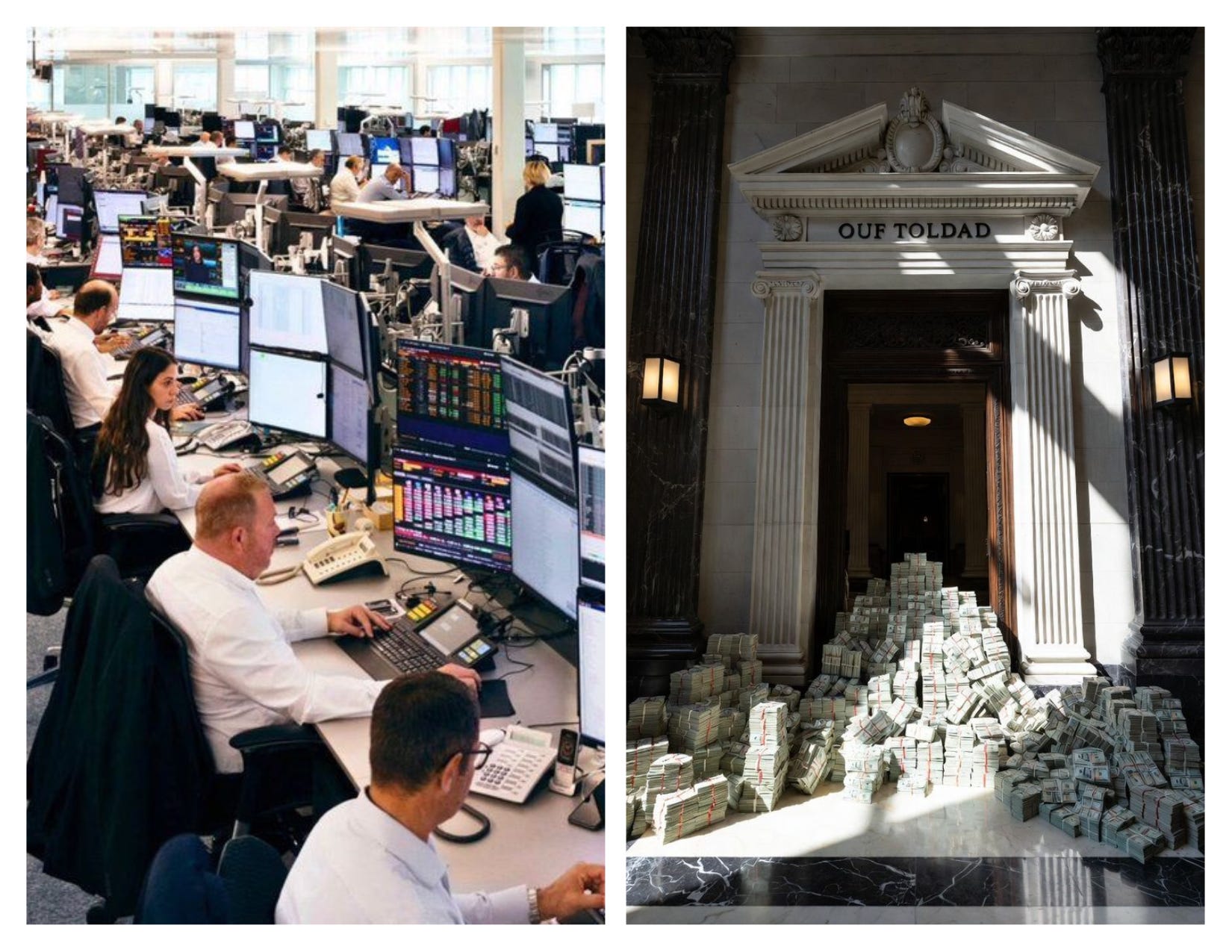
I feel like every time I open social media, someone is blaming PE for the downfall of a major corporation. For instance, most recently, I was shopping for a birthday dress at Reformation (a sustainable women’s fashion brand known for its ethical, fast-fashion approach). While shopping, I overheard a group of girls my age, one of them saying, “Reformation’s quality has gone down so much recently, the stitching on this skirt is absolutely horrendous.” With one of her friends replying to her comment saying, “That is what Private Equity does best, it sinks companies down to the ground.”
There is a growing habit in business and public commentary that is starting to feel less like analysis and more like shorthand: when a company declines, the explanation arrives almost automatically—Private Equity did it.
I can’t lie, it is a satisfying story. It has villains, it has leverage, it has spreadsheets instead of soul. It also lets us avoid the more uncomfortable truth: most companies don’t collapse because of one moment of financial engineering. They decline slowly, structurally, and often predictably long before any buyout happens.
Private Equity just arrives at the scene when the smoke is already visible. And perhaps this makes me sound a bit of a capitalist, but I don’t think it is fair to say that PE is the reason for every corporation’s demise.
It made me think: Is PE to blame for the downfall of many corporations in recent years?
For example, Toys’ R ‘ Us was acquired in 2005 for $6.6 billion in a leveraged buyout by KKR & Co., Bain Capital, and Vornado Realty Trust. The company was saddled with $5 billion in debt, forcing it to pay nearly $400 million in interest, which ultimately hindered its ability to compete and led the toy conglomerate to file for bankruptcy in 2017.
Another prominent example is Gymboree, a children’s apparel and early-childhood enrichment program. It was acquired by Bain Capital in 2010 for $1.8 billion dollars in a leveraged buyout, which later led to financial distress due to high debt levels. In 2017 and 2019, the company went through two bankruptcies following declining sales and heavy debt loads, leading the brand to sell its rights to Children’s Place in 2019.
We keep blaming PE for the decline of beloved companies. But that explanation is too simple. Most of the time, PE doesn’t destroy businesses; it exposes what is already fragile and accelerates what was already changing.
I argue that PE has numerous success stories we tend to overlook. There are numerous success stories of firms transforming underperforming companies, accelerating growth, and generating significant value. Successful PE investments often involve operational improvements, capital investment, and strategic acquisitions. With the success stories of Dunkin Brands, Hilton Worldwide, Dell Technologies, Petco, and Strayer Education, Inc.
It is easy to see why PE becomes the scapegoat. The changes are visible. Soon after a company is acquired, headcount shrinks, assets are sold, prices change, and operations are streamlined. These are not only tangible shifts but also transformational.
The uncomfortable reality many people aren’t willing to recognize is that many of the businesses people actively cite as ruined were already structurally weakened before any deal ever happened.
Given my examples above, retail is the clearest example. Long before PE became a talking point, physical retail was already under pressure from e-commerce, shifting consumer habits, and over expansion. The model itself was losing relevance. The same patterns are shown across various industries.
Legacy brands are failing to adapt to digital distribution, have slow product innovation cycles, overbuilt cost structures, and leadership teams that prioritize stability over reinvention.
Here is what the general public doesn’t see: By the time Private equity arrives, it is not often buying a thriving organism; it is buying something that is already metabolically slowing down. And from any perspective, at that point, the intervention looks aggressive because the baseline was already unstable.
PE firms follow a simple logic: acquire, restructure, improve efficiency, and exit. The model isn’t designed to diagnose cultural meaning or preserve nostalgia. It is designed to correct inefficiencies in capital allocation and operations within a finite time window.
What I am saying here is that two things can be true at once: While yes, some firms over-optimize and make long-term trade-offs that hurt brand equity or employee morale, they are still responding to a set of underlying business fundamentals that already exist.
PE is rarely the root cause of decline; rather the amplifier of reality.
Blaming PE works socially because it simplifies something that is actually complex. It also aligns with how we experience modern capitalism. Fast changes, visible disruptions, and a general sense that “things used to be better.” While a favorite brand changes, it is emotionally easier to attribute that shift to a new owner than to accept that the underlying market has moved on.
There is a psychological convenience in assigning agency to a single actor. “Private Equity ruined it” is cleaner than saying, “this company failed to evolve while its industry changed over 15 years ago.”
One explanation feels like injustice; the other feels like entropy.
The private equity narrative persists because it offers a clear moral structure in a system that rarely does. It turns slow decay into intentional harm. It turns market evolution into corporate wrongdoing. It turns complexity into clarity. But clarity is not the same as truth.
And if you actually care about understanding how companies rise and fall, the harder—but more accurate—view is this:
Most businesses are already halfway down the path long before anyone notices. Private equity doesn’t begin the story. It usually enters in the middle, and sometimes just writes the ending faster than people expected.
Never heard about this, interesting perspective